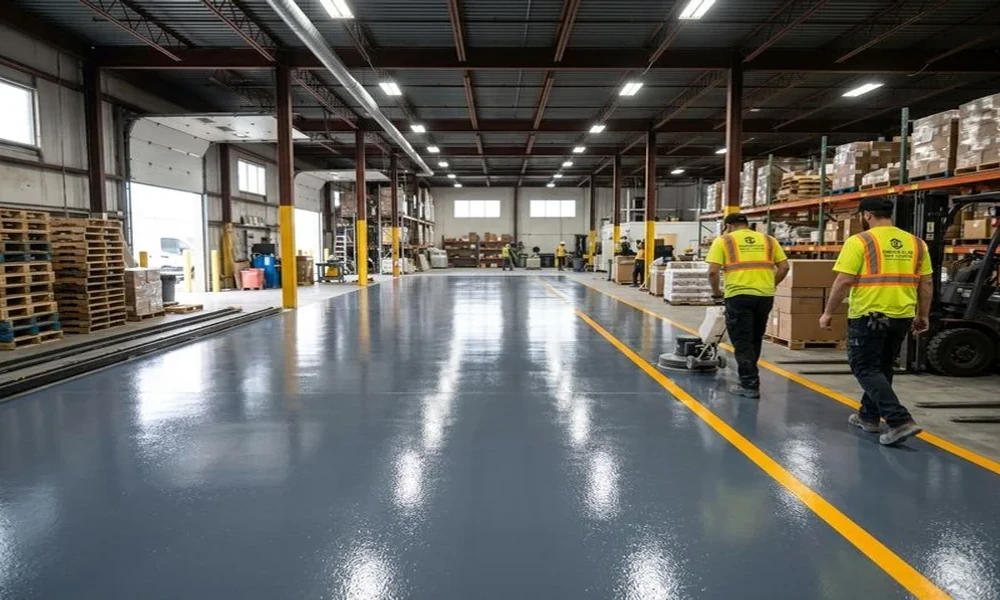

A commercial floor works harder than any other surface in the building. Forklifts crush it, wash-downs soak it, chemicals attack it, and the business above it cannot stop for long while it is fixed.
Choosing the wrong system leads to peeling, slippery patches and repeat shutdowns. Choosing the right one gives you a seamless, hygienic, low-maintenance floor for years.
This guide explains what commercial epoxy flooring in the GTA needs to withstand, which systems suit which facilities, and how installation can be scheduled around a working business.
What Commercial Epoxy Flooring Has to Withstand
- Heavy loads. Industrial-grade systems are built for forklifts, machinery and constant foot traffic.
- Hygiene demands. Epoxy forms a seamless, non-porous surface with no grout lines or crevices where bacteria and mould can grow.
- Chemicals and stains. Oils, cleaning agents and industrial fluids sit on the surface instead of soaking into the concrete.
- Low maintenance. A properly installed floor eliminates recurring concrete repair and resealing costs.
Toroo Coatings has more than 10 years of experience installing commercial epoxy flooring in the GTA, working across business and industrial corridors such as the Airport Corporate Centre, Meadowvale Business Park, Vaughan Metropolitan Centre, Brampton’s Highway 410 corridor and the Markham and Scarborough industrial zones. Systems are matched to each space’s hygiene, chemical resistance and traffic requirements.
Commercial Epoxy Flooring Systems by Facility Type
Warehouses and Factories
Epoxy is the base system, bonding to concrete for a hard, chemical-resistant surface. Polyurethane is typically applied as a topcoat, adding flexibility and impact resistance where forklift traffic and mechanical shock are constant.
Commercial Kitchens and Food Production
Urethane cement systems are designed for wet, hygienic areas. They resist thermal shock, are slip-rated and create a seamless surface that resists mould and bacteria, which suits restaurants and food production environments.
Retail Stores and Showrooms
Decorative metallic epoxy creates marble-like patterns for brand-forward spaces, while flake and quartz systems add texture and slip resistance. These systems are seamless, durable and easy to clean.
Hospitals and Healthcare
Seamless, hygienic systems support infection control and easy sanitation, where cleanliness and durability are non-negotiable.
Schools, Gyms and Fitness Facilities
Durable, high-traction systems suit multipurpose gyms, fitness centres and training facilities, where constant movement and equipment loads wear softer surfaces quickly.
Anti-slip additives, such as aluminum oxide or broadcast aggregates, can be added to epoxy and polyurethane systems for wet and high-traffic areas.
Installing Commercial Epoxy Flooring Without Shutting Down
Downtime costs money, so scheduling matters as much as materials.
- Work around your hours. Installations can run at night and on weekends.
- Phase large facilities. Sections can be coated while other sections remain accessible.
- Plan the timeline. Commercial projects typically take three to five days or longer depending on size and complexity. Each coat needs 8 to 24 hours to cure before the next, and heavy traffic generally needs five to seven days.
Ask for a written schedule that shows when each zone will be out of service and when it can be used again.
Commercial Floor Resurfacing: Fix Before You Replace
A failing floor does not always need a full rebuild. Common warning signs include:
- Peeling, bubbling or delaminating topcoat
- Visible cracks or failed expansion joints
- Drainage problems or pooling water
- Faded, chipped or missing safety line markings
Resurfacing typically includes a condition assessment, crack repair and base remediation, removal of failed coating layers, and a fresh system with new safety line markings.
Questions to Ask a Commercial Epoxy Flooring Contractor
- How will you handle downtime? Look for night, weekend or phased options, not a blanket shutdown.
- Which system fits our chemicals and traffic? Vague answers signal a one-size-fits-all approach.
- How is the slab prepared? Mechanical grinding, moisture testing and crack repair should be standard.
- Is the floor slip-resistant when wet? Ask about anti-slip additives for wash-down and kitchen areas.
- When can we return to full use? Return-to-use times depend on the system and conditions, so get dates in writing.
What Commercial Epoxy Flooring in the GTA Costs
Commercial epoxy flooring in Toronto generally runs between $6 and $12 per square foot, depending on the system, surface condition and finish. Larger projects often have lower per-square-foot costs. Toroo’s pricing guide puts a retail store at about $3,000 to $12,000 and up, a restaurant kitchen at $2,500 to $8,000, a warehouse at $8,000 to $50,000 and up and a factory at $15,000 to $100,000 and up, depending on size and system. High-traffic commercial floors typically last 10 to 15 years when properly installed. Ask for an itemized quote that covers preparation, repairs and the coating system.
Final Thoughts on Commercial Epoxy Flooring in the GTA
Match the system to what the floor actually faces: loads, chemicals, hygiene rules and foot traffic. Insist on proper preparation, and choose an installer who can schedule around your operations rather than asking you to stop them.