
Most people think of a water heater as one object: a tank in the corner of the basement that either works or doesn’t. In practice, it sits where several paths through the house meet. Cold water flows in, gas or electricity adds heat, exhaust has to leave, pressure has to go somewhere when water expands, and a leak, if one ever happens, will run downhill. A good installation plans for each of those paths.
That matters more in Eastern Iowa than in many places. Winters chill the water coming into the home, older basements were rarely laid out for modern equipment, and many houses still use venting designed decades ago. Homeowners looking into Iowa City water heater installation often focus on tank size and price, but the details around the tank usually decide how long it lasts and how safely it runs.
Thinking in terms of paths turns a confusing purchase into a few simple questions. Here is how each one plays out.
The Cold Water Coming In
Every gallon of hot water starts as cold water from the street or a well. In January, that water can be far colder than in August, sometimes dropping into the 40s. A heater set to 120 degrees then has to raise the temperature by about 75 degrees instead of 50 or 60.
With a tank heater, this shows up as slower recovery. A family that runs back to back showers on a winter morning may find the last person gets lukewarm water, even though the same tank kept up fine all summer. The first hour rating on the yellow label tells you more about real capacity than the gallon size does.
With a tankless unit, the effect is bigger. Flow rate depends on how much the unit has to raise the water temperature. A model that easily runs two showers in July might only manage one and a half in February. Size it for winter, not for an average day.
Water quality comes in here too. Many homes in the region have hard water, especially those on private wells. The minerals settle as sediment in tanks and build up as scale inside tankless heat exchangers. A softener, a drain valve you can actually reach, and a plan for regular flushing should all be part of the conversation before the new unit goes in.
Where the Heat Comes From
The energy source shapes almost everything else.
Gas tanks are still common in older neighborhoods because the gas line and vent are usually already there. Replacing like for like is often the simplest choice.
Standard electric tanks need no venting, but in many homes they cost more to run, and they need a properly sized dedicated circuit.
Heat pump water heaters pull warmth from the surrounding air. ENERGY STAR notes that heat pump water heaters work best in spaces that stay between 40 and 90 degrees all year with plenty of air around them. A finished or partly finished basement often fits. A cramped utility closet or a cold attached garage usually doesn’t. These units also cool and dry the air around them, which helps in a muggy basement in summer but adds a slight chill in winter.
Tankless gas units save space and give endless hot water within their flow limits, but they often need a larger gas line and new venting.
The Exhaust Going Out
Every gas water heater produces combustion gases, and they have to leave the house reliably. Older atmospheric heaters rely on hot exhaust rising through a metal vent, often shared with the furnace through a masonry chimney. When a high efficiency furnace replaces the old one, the water heater can end up alone in a chimney that’s too big for it. The exhaust cools, condenses and may spill back into the basement.
A careful installer checks the draft once the new heater fires, looks at vent pitch and connections, and makes sure the room has enough combustion air. Power vent and condensing models vent through a side wall with plastic pipe. That solves many chimney problems, but the vent needs to end away from windows and snow drifts. The U.S. Consumer Product Safety Commission recommends carbon monoxide alarms on every level of the home and outside sleeping areas, which makes sense for any household with gas appliances.
The Pressure Building Up
Water expands when it heats. In older plumbing, that extra volume could push back into the city main. Many homes now have a pressure reducing valve or check valve that blocks that route. This creates a closed system, so pressure climbs every time the burner or element runs.
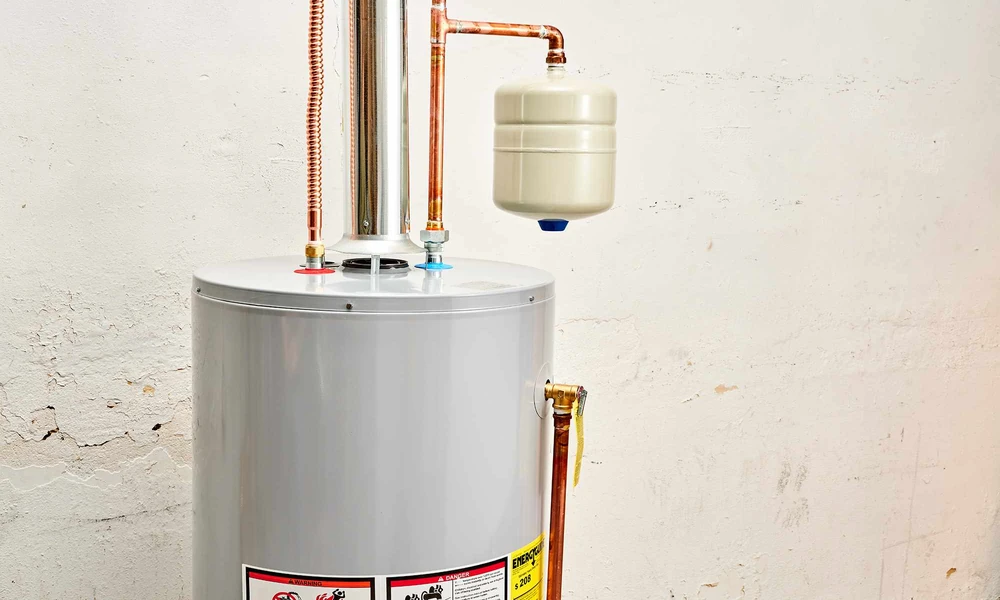
Two parts deal with this. A thermal expansion tank on the cold line gives the extra water somewhere to go. The temperature and pressure relief valve on the heater is the last line of defense. Its discharge pipe should run down to a point near the floor or a drain, and it should never be capped or narrowed. A relief valve that drips often usually points to an expansion problem, not a faulty valve.
Where a Leak Would Travel
Every tank eventually fails, and the question is where the water goes when it does. In an unfinished basement with a floor drain nearby, a slow leak might go unnoticed for weeks. In a finished lower level or a first floor laundry room, the same leak can ruin flooring and drywall.
A drain pan piped to a drain, a leak sensor that alerts your phone, or an automatic shutoff valve costs little next to the damage it prevents. Placement matters too. Clear space around the heater lets someone reach the shutoff valve, drain valve and anode rod without moving boxes first.
Bringing It All Together
When the old tank comes out, it’s tempting to set the new one in the same spot, reuse the same connections and call it done. Sometimes that is exactly right. Other times the vent no longer drafts well, the house never had an expansion tank, or a heat pump model would suit the basement better than another gas tank.
Checking each path before work starts takes only a few minutes, and it turns the job into an upgrade instead of a simple swap. You end up with hot water that keeps up in January, exhaust that leaves the house the way it should, and a basement that stays dry when the tank finally wears out years from now.